Shoutout to my high school algebra and geometry teacher.
Suppose \(\frac{a}{b}\) and \(\frac{c}{d}\) are adjacent reduced fractions with \(b,d>0\). Then \(|ad-bc|=1\), and their Ford circles are externally tangent. Their radii and centers are
\[ R_1=\frac{1}{2b^2},\qquad R_2=\frac{1}{2d^2}, \]
\[ C_1=\left(\frac{a}{b},R_1\right),\qquad C_2=\left(\frac{c}{d},R_2\right). \]
We know from the section formula that a point \(P\) dividing the segment from \(A=(x_1,y_1)\) to \(B=(x_2,y_2)\) in the ratio \(\operatorname{distance}(A,P):\operatorname{distance}(P,B)=m:n\) has coordinates
\[ P=\left(\frac{nx_1+mx_2}{m+n},\;\frac{ny_1+my_2}{m+n}\right). \]
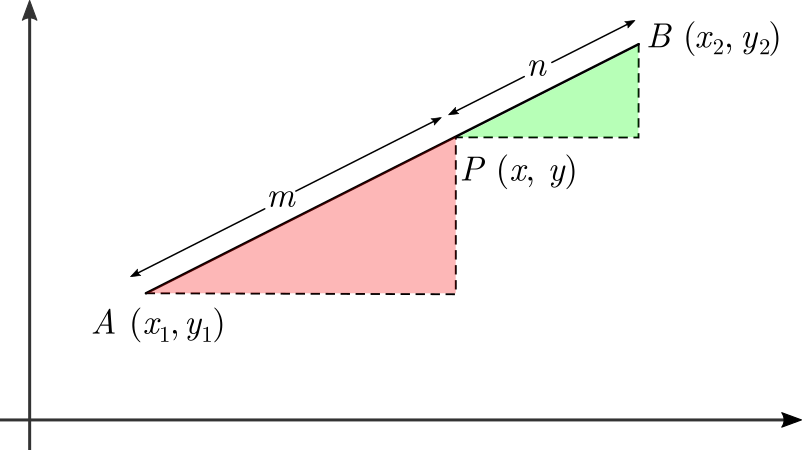

The tangent point \(T\) lies between the centers, at distances \(R_1\) and \(R_2\) from \(C_1\) and \(C_2\), respectively. So we can substitute \(A=C_1\), \(B=C_2\), \(m=R_1\), and \(n=R_2\):
\[ \begin{aligned} T &=\left( \frac{R_2\frac{a}{b}+R_1\frac{c}{d}}{R_1+R_2}, \;\frac{R_2R_1+R_1R_2}{R_1+R_2} \right)\\[6pt] &=\left( \frac{\frac{a}{2bd^2}+\frac{c}{2db^2}} {\frac{1}{2b^2}+\frac{1}{2d^2}}, \;\frac{\frac{1}{2b^2d^2}} {\frac{1}{2b^2}+\frac{1}{2d^2}} \right)\\[6pt] &=\boxed{\left(\frac{ab+cd}{b^2+d^2},\;\frac{1}{b^2+d^2}\right)}. \end{aligned} \]
Since \(b,d>0\), we have \(b^2>0\) and \(d^2>0\), so \(b^2+d^2>0\). Thus the denominator is nonzero. Both numerators and the denominator are integers, so both coordinates are rational.